
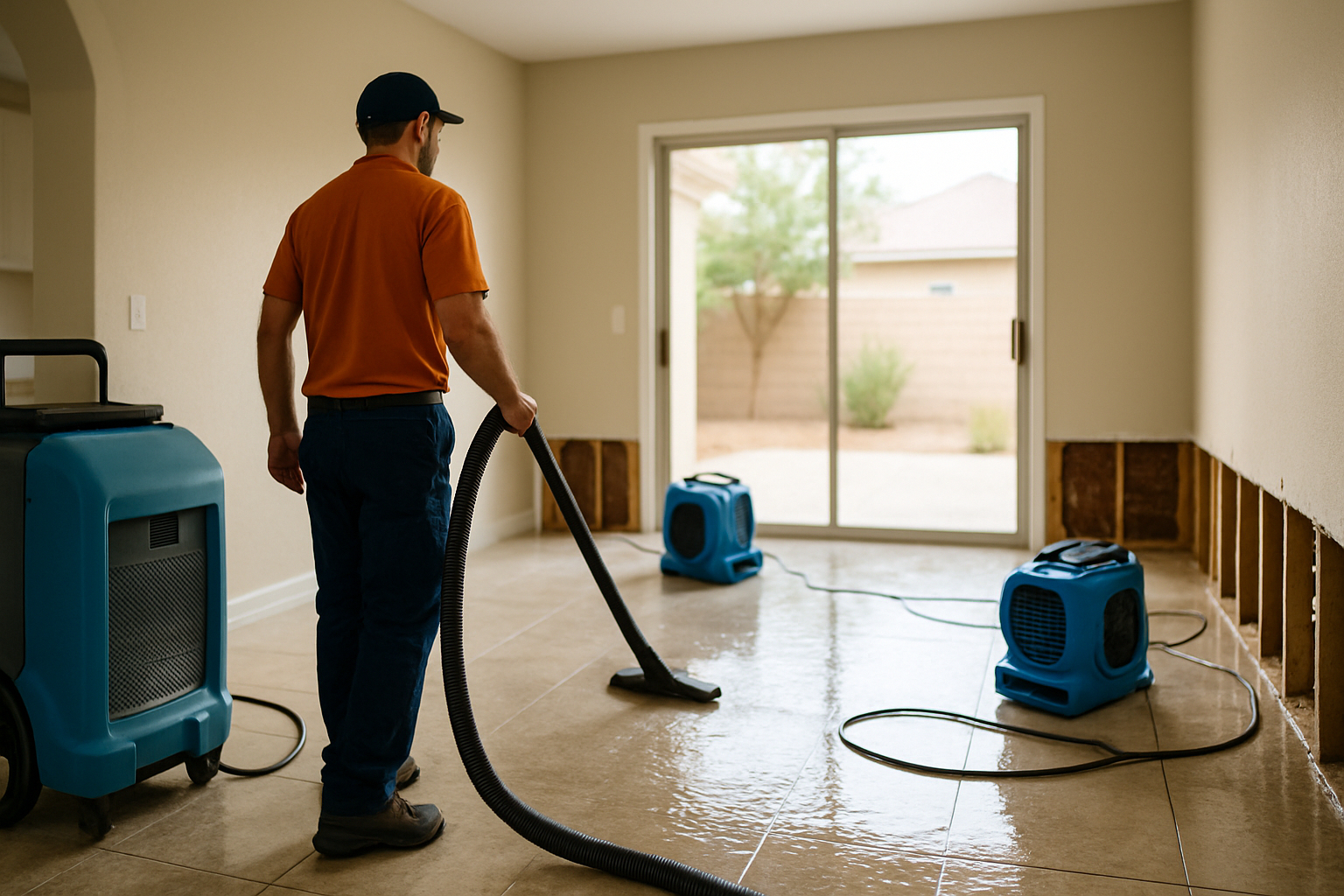
A burst supply line gives you about an hour of useful thinking time. Most homeowners spend it searching, calling, and hiring whatever crew answers first. That single choice shapes your repair bill, your insurance outcome, and whether mold appears three weeks later. The contractor you pick under pressure matters more than the water itself. Here is how to vet one properly, even while the clock runs.
Key Takeaways
- ›Verify the state licence and IICRC certification before you sign anything.
- ›Insist on a written scope with drying targets and daily moisture readings.
- ›Insurance covers sudden, accidental damage, not slow leaks left unrepaired.
Start With Credentials You Can Verify Yourself
Anyone can print "certified" on a van. Your job is to confirm it independently, in about five minutes, before work begins.
Check the Arizona licence number
Arizona licenses contractors through the Registrar of Contractors, known as AZ ROC. The agency regulates more than 60,000 residential and commercial contractors statewide. Ask for the licence number, then look it up in the AZ ROC contractor search. You are checking three things. Is the licence active? Does the classification actually cover restoration work? And are complaints stacking up against it? A crew that hesitates to give you a number has told you something useful.
Ask about IICRC certification by name
The restoration industry runs on standards from the Institute of Inspection, Cleaning and Restoration Certification. Its standards are consensus documents built through an ANSI-accredited process. Certification means a technician trained against those documents rather than learning on your floor. Ask which technicians hold it and in what categories. Water restoration and applied structural drying are the two that matter here.
Confirm insurance, not just licensing
A licence is not coverage. Ask for a certificate of insurance naming general liability and workers’ compensation. Uninsured crews shift risk onto your homeowners policy if someone is hurt in your house.
What a Legitimate Scope of Work Looks Like
Restoration companies inspect, extract, dry, clean, and rebuild until a property returns to its prior condition. That sequence should appear on paper before anyone unrolls a hose.
The stages you should see written down
A complete scope names the water source and confirms it is shut off. It categorises the water as clean, grey, or black, because contamination changes everything downstream. It lists affected materials room by room. It states what gets dried in place and what gets removed. Finally, it separates mitigation from reconstruction, so you can see both numbers clearly.
Drying targets instead of drying days
Weak scopes promise "three to five days." Strong scopes commit to a moisture content target for each material. Ask for daily readings with a meter, logged and shared. Those logs are also your evidence if an adjuster questions the work later. No documentation means no leverage.
Who handles the rebuild
Mitigation dries the structure. Reconstruction puts back drywall, paint, cabinets, and flooring. Some companies only do the first part, then hand you a referral. Bright Home Construction handles both stages in-house, which matters because a single accountable party cannot blame the other one for a gap.
Red Flags That Should End the Conversation
Some warning signs appear before the first invoice. Three deserve particular attention when you are rushed.
Pressure to sign over your insurance benefits
Some contractors ask you to sign an assignment of benefits. That paperwork can hand them the right to bill and negotiate with your insurer directly. It is not automatically wrong, but it is rarely urgent. Read it away from the doorstep, or have your adjuster read it first.
Vague answers about equipment and monitoring
Ask how many air movers and dehumidifiers the job needs, and why that number. A qualified estimator ties equipment counts to room volume and material type. Guesswork here usually means undersized drying and a callback.
A quoted price before anyone inspects
Water damage cannot be scoped over the phone. A firm number offered sight unseen is either padded or destined to change. Expect an inspection, moisture mapping, then a written figure.
Six Questions to Ask Before You Sign
Keep these on your phone. They take two minutes and they filter hard.
- What is your licence number, and what classification is it under?
- Which technicians on this job hold IICRC certification, in which categories?
- Will you give me daily moisture readings in writing?
- Does this estimate separate mitigation from reconstruction?
- Am I signing anything that assigns my insurance benefits to you?
- Who is my single point of contact for the whole job?
Any competent company answers all six without friction. Hesitation on the licence or the paperwork question is the signal worth acting on.
Documentation Decides Your Claim
Your insurer will reimburse what someone can prove. The contractor you hire either builds that proof or leaves you arguing from memory.
Ask the crew to photograph every affected room before extraction starts. Ask for the moisture map, the equipment log, and the daily readings as files you keep. Those records establish that damage was sudden, that response was prompt, and that drying met a standard. Keep your own receipts for temporary lodging and emergency plumbing repairs too.
A company that resists sharing its documentation is protecting itself, not you. That single test separates most serious operators from the rest.
How the Local Climate Changes Your Drying Plan
Tempe sits in a low-humidity desert, which sounds like an advantage. It partly is, because dry outdoor air speeds evaporation from exposed surfaces. The catch is that surface dryness hides trapped moisture inside walls and under tile beds. Monsoon weeks flip the picture entirely, pushing humidity up just as storm damage peaks.
A contractor who works here should explain that swing without prompting. Cooling systems add another path, since condensate lines and air handlers create damp cavities year-round. That mechanism is common enough locally that it deserves its own explanation of hidden cooling-system mold. Ask how the plan accounts for both.
The Threshold That Tells You When DIY Stops
There is a published line for mold, and it is worth knowing before you negotiate. The EPA’s guidance on mold cleanup puts the self-help limit near ten square feet, roughly a three-by-three patch. Past that, or after significant water damage, it directs homeowners to professional help.
The same guidance is blunt about vetting. It tells you to hire a contractor with genuine mold experience, to check references, and to require work that follows IICRC guidelines. It also singles out sewage and contaminated water as specialist territory. When you are weighing a water damage restoration contractor Tempe homeowners recommend, those are reasonable minimum demands.
Frequently Asked Questions
Verify First, Sign Second
Water damage rewards preparation you did earlier. Save a licence number, a certification, and a phone number now. Then the decision is already made when a line lets go at midnight.
Our crews handle water damage restoration in Tempe with 24-hour emergency response, documented drying, and direct insurance help. Bright Home Construction also covers mold removal services when moisture has been sitting longer than anyone realised. Book now if water is moving today. If not, save a water damage restoration contractor Tempe residents already trust in your phone. Then call Bright Home Construction when you need the moisture found rather than guessed at.