
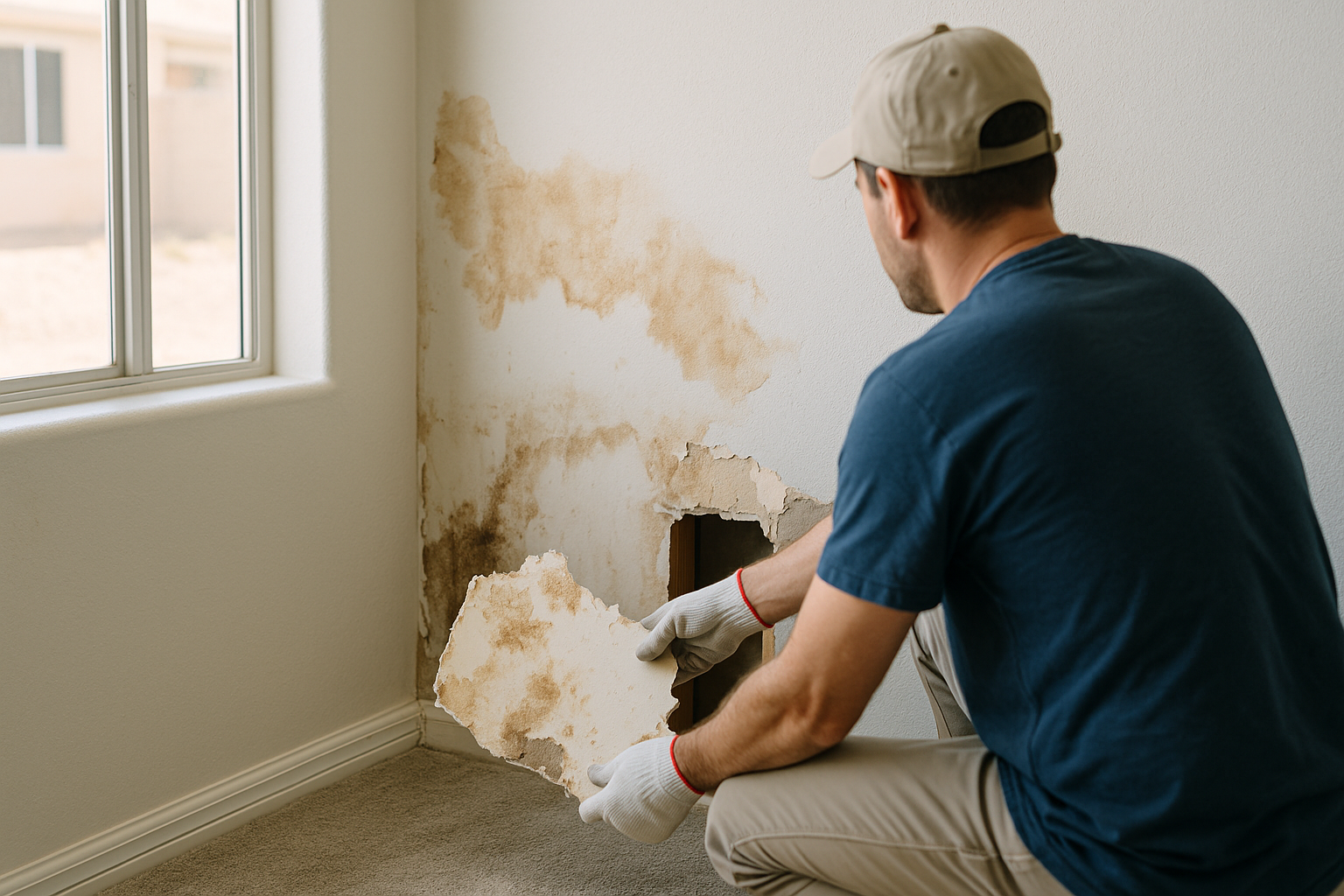
Water just hit your Phoenix home — slab leak, AC condensate failure, monsoon roof penetration — and now you're looking at wet drywall. The next question every Valley homeowner asks: do I dry it in place, or does it all come out?
This guide covers the repair vs replace decision tree for water-damaged drywall in AZ homes — the 12-hour rule, the structural tests pros use, and the slab-leak and AC-condensate scenarios that complicate the call for Phoenix-area properties.
Key Takeaways
- Drywall wet less than 12 hours can often be dried in place; beyond 12 hours, replacement is usually faster and safer.
- Visible warping, swelling, or soft spots = always replace, regardless of how recent the water exposure.
- Slab leaks and AC condensate failures often mean drywall has been wet for weeks even when the visible damage looks fresh.
Start With the 12-Hour Rule
The most important variable is time-since-saturation. Paper-faced drywall absorbs water fast. Within 12 hours, professional drying (commercial dehumidifiers + air movers, holding humidity below 60%) can usually pull the moisture back out and leave drywall structurally intact. Past 12 hours, the paper face is typically compromised — surface dryness lies because mold has often started inside the layered paper face.
When You Can Repair (Dry In Place)
- Wet less than 12 hours
- Drywall still firm when pressed firmly
- No visible swelling, bulging, or sagging
- Small contained area (single section, under 8 sqft)
- Source of water identified, stopped, and was clean (Cat 1)
- Professional moisture meter confirms drying targets within 72 hours
When Replacement Is the Right Call
- Wet more than 12 hours (this is the most common AZ scenario for slab leaks and AC condensate)
- Visible warping, bulging, sagging, or any deformation
- Soft spots when pressed
- Drywall is below the visible water line on flood-affected walls
- Mold visible OR persistent musty smell
- Multiple walls or ceilings affected
- Cat 2 (gray water) or Cat 3 (sewage) water source
Phoenix Slab Leak Reality
Slab leaks are the #1 hidden water source in Phoenix-area homes. When water from a slab leak reaches drywall, the leak has typically been running for weeks. The drywall hasn't been wet 12 hours — it's been wet 4-8 weeks. Surface dryness lies. Mold has often established inside the wall cavity before staining ever appears on the painted surface.
What this means in practice: when the diagnosis is a slab leak (confirmed by leak detection equipment), assume replacement for any drywall showing visible damage. Trying to dry in place rarely succeeds at the underlying problem and frequently leads to mold appearing 3-6 months later.
AC Condensate Pattern
Phoenix homes run AC 8-9 months per year. Condensate drain pans and condensate lines fail slowly — water drips for weeks before ceiling drywall stains visibly. By the time you see the brown ring on the ceiling, the drywall paper above it has been saturated and re-drying in cycles for a long time. Replacement is almost always required for AC-condensate-affected ceiling drywall.
Professional Tests Used to Decide
Moisture Meter Reading
Pin or pinless meters measure water content directly. Drywall above 1.0% MC supports mold growth; IICRC target for 'dry' is 0.7% or lower. Without a meter reading, visual inspection misses hidden moisture in wall cavities.
Thermal Imaging
Infrared cameras show temperature differences — wet materials are cooler than dry. Pros use thermal imaging to find moisture behind paint and identify the actual extent of saturation, often 2-4x larger than what's visible from outside.
Structural Test
Press firmly into the drywall with a thumb. Solid drywall resists; compromised drywall gives way. The pros also do a tap test — solid drywall sounds firm; compromised drywall sounds muffled.
Cost Comparison: Repair vs Replace
- Dry-in-place restoration: $200-$600 per wall section (commercial equipment, monitoring, no material replacement)
- Cut, replace, and finish drywall: $400-$1,200 per wall section (drywall, taping, mudding, sanding, priming, painting)
- Full ceiling replacement: $800-$2,500 (more labor for overhead work and texture matching)
- Insurance typically covers either path when the source is a covered event
Can drywall be dried with fans and dehumidifiers?
Sometimes, with commercial-grade equipment (90-150 pint dehumidifiers, high-velocity air movers — not consumer fans) and only when caught within 12 hours of saturation. Pros measure moisture content to confirm drying actually reaches IICRC targets; visual dryness alone isn't enough.
How long does drywall take to dry after water damage in Phoenix?
With commercial equipment: 24-72 hours to reach targets in Phoenix dry climate. Consumer fans: 5-10 days, often without reaching targets. Slab-leak scenarios where moisture has been present for weeks may not respond to drying at all — replacement is typically required.
Will mold grow in dried drywall after water damage?
Only if drying didn't reach IICRC moisture content targets (below 0.7% for drywall) and didn't address the underlying source. Properly dried drywall with leak source fixed rarely develops mold. Improperly dried drywall almost always does — often months later when you least expect it.
Can I cut wet drywall myself?
Small contained Cat 1 (clean water) sections under 4 sqft are reasonable DIY for handy homeowners. Anything larger, contaminated water, structural concerns, or mold visible needs professional removal. Improperly cut contaminated drywall releases spores throughout your home.
Got Wet Drywall in Your Phoenix Home?
The repair-vs-replace decision depends on factors you can't always assess visually — time-since-saturation, moisture content, structural integrity, and the water source's history.
Get a professional assessment from a Water Damage Restoration Phoenix team that uses moisture meters and thermal imaging to determine actual saturation extent, then quotes both repair and replacement options. Across Phoenix, Mesa, Tempe, and the Valley, IICRC-certified and equipped for slab-leak scenarios that hide damage for weeks.