
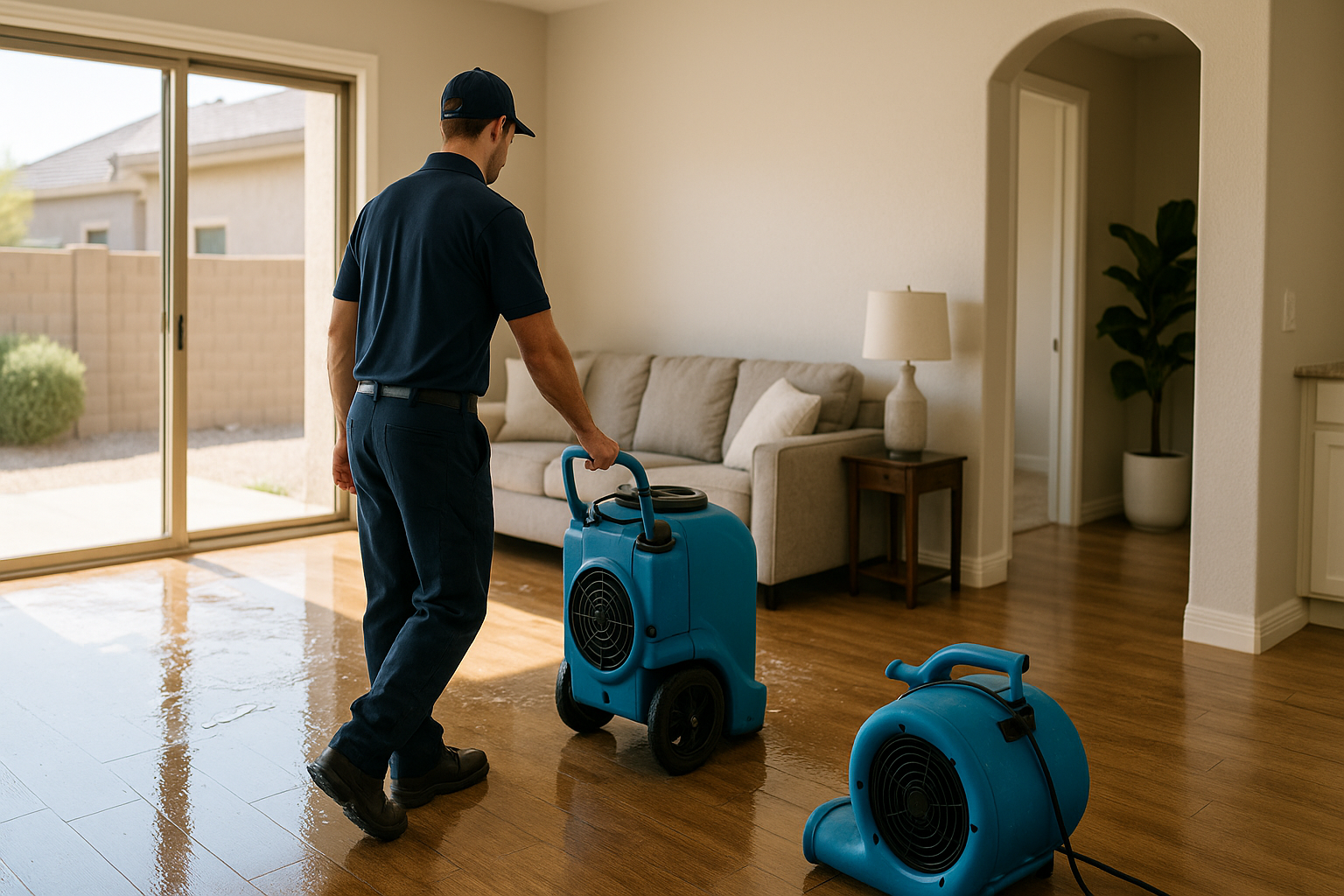
Your Mesa home took water — slab leak, monsoon roof penetration, AC condensate failure. You called a restoration company. Now what actually happens? Most homeowners go through restoration once or twice in their lifetime; the process feels opaque the first time.
This guide walks through the 8-step water damage restoration process in Mesa, AZ — what your crew should do in order, why each step matters, and what to watch for to know you're getting professional work rather than a checkbox exercise.
Key Takeaways
- Restoration is a structured 8-step process — skipping steps (especially moisture measurement) is how mold shows up months later.
- Active drying time runs 3-5 days for typical Mesa losses; Maricopa dry climate helps, but slab leaks add days for hidden moisture.
- Documentation throughout protects your insurance claim — every step should generate photos, moisture readings, and a scope record.
The 8-Step Mesa Water Damage Restoration Process
Step 1: Emergency Response and Assessment (Hours 0-2)
Crew arrives, evaluates the scope, documents with photos, identifies the water source, and creates an initial scope of work. Cat 1 (clean water), Cat 2 (gray water), Cat 3 (sewage) classification happens here — this drives PPE, equipment, and materials decisions for everything that follows.
Step 2: Water Extraction (Hours 2-6)
Commercial-grade truck-mounted extraction or portable extractors remove standing water and surface moisture. Every minute water sits, it migrates deeper into materials. The faster extraction completes, the less subsurface drying is needed later.
Step 3: Content Manipulation and Removal (Hours 6-12)
Salvageable contents (furniture, electronics, paper goods, valuables) move to a dry area or contents pack-out for off-site cleaning. Unsalvageable items get documented and disposed of with insurance documentation. Wet contents in a wet space accelerate everything bad.
Step 4: Material Removal (Hours 12-24)
Wet drywall beyond 12 hours, wet carpet pad, wet insulation come out. Mesa dry climate doesn't change this — saturated paper-faced materials become mold reservoirs regardless of how fast they're surface-dry. Cut drywall 2 inches above the visible water line minimum.
Step 5: Active Drying Setup (Day 1-2)
Commercial dehumidifiers (90-150 pint/day) and high-velocity air movers go into place. Equipment count and positioning is engineered based on cubic feet of affected area, wall types, and moisture readings. Real crews calculate this; checkbox crews drop a few fans and walk away.
Step 6: Daily Monitoring (Days 2-5)
Moisture readings logged daily per location. Equipment placement adjusted as readings change. IICRC S500 standard targets: drywall to 0.7% moisture content, framing to 16%, hardwood to 9%, concrete to 4%. Hitting these targets is the difference between successful drying and hidden mold weeks later.
Step 7: Antimicrobial Treatment (Day 4-5)
EPA-registered antimicrobial spray applied to all previously-wet surfaces. This kills mold spores that may have started colonizing during drying. Skipping this step in Mesa's slab-leak scenarios (where water has been there longer than 12 hours) often leads to mold appearing 3-6 months later.
Step 8: Reconstruction (Week 2-3)
Drywall replacement, paint, flooring, trim. This is the visible part of the project. Sometimes handled by the restoration company, sometimes referred to a general contractor. Either way, materials and finish should match pre-loss condition or insurance scope.
What to Watch For During Each Step
- Step 1: Insist on Cat 1/2/3 classification in writing — affects everything that follows.
- Step 2: If extraction takes more than 24 hours from your call, equipment or staffing is undersized for your loss.
- Step 3: Get a written contents inventory before items leave your property.
- Step 4: Photo-document material removal — adjusters need this.
- Step 5: Ask how many air movers and dehumidifiers are placed and why — real crews can explain their calculation.
- Step 6: Demand daily moisture readings in writing — your only proof drying actually reached targets.
- Step 7: Verify antimicrobial product name and EPA registration number.
- Step 8: Get a written reconstruction scope before any rebuild work starts.
Mesa-Specific Considerations
Maricopa County water damage has region-specific patterns. Slab leaks are the #1 hidden source — water from a slab leak has often been there weeks before drywall starts staining, so the 'within 12 hours' window for in-place drying rarely applies. AC condensate failures cause the same pattern: ceiling drywall below interior air handlers stains slowly over weeks before discovery. Monsoon roof penetrations (June-September) cause sudden water damage that benefits most from fast extraction but adds humidity to indoor drying environments. Real Mesa crews scope accordingly; out-of-area crews quoting from national templates often miss these patterns.
How long does water damage restoration take in Mesa?
Typical timeline: extraction and drying setup day 1, active drying 3-5 days, reconstruction 1-3 weeks depending on scope. Mesa's dry climate often shortens drying compared to humid markets, but slab leaks and AC condensate failures with hidden long-term moisture extend timelines.
Can I stay in my Mesa home during water damage restoration?
Usually yes for small contained losses with Cat 1 (clean) water. Larger losses, multiple rooms affected, or Cat 2/3 water often require temporary relocation — your insurance usually covers Additional Living Expenses (ALE) during the work.
Will mold grow if drywall isn't replaced after water damage?
Yes, often — if the underlying paper face was saturated more than 12 hours, mold can establish inside the layered paper even after surface drying. This is why pros cut out wet drywall rather than try to dry it in place beyond the 12-hour window.
What if hidden water shows up after my restoration is 'done'?
This happens with slab leaks and hidden cavity moisture. Reputable Mesa restoration crews offer post-completion warranties — call them back and they should re-inspect and remediate any newly-discovered moisture. Document everything in writing.
Got Water Damage in Mesa Right Now?
Every step in the restoration process matters; the difference between a clean recovery and ongoing mold problems lives in steps 5-7 (drying targets, monitoring, antimicrobial).
Get a structured, documented process from a Water Damage Restoration Mesa crew that follows IICRC S500 standards step-by-step, with daily moisture readings, written scope, and direct insurance billing. Across Mesa, Gilbert, Chandler, and Tempe, our team brings the equipment and certification AZ losses require.